
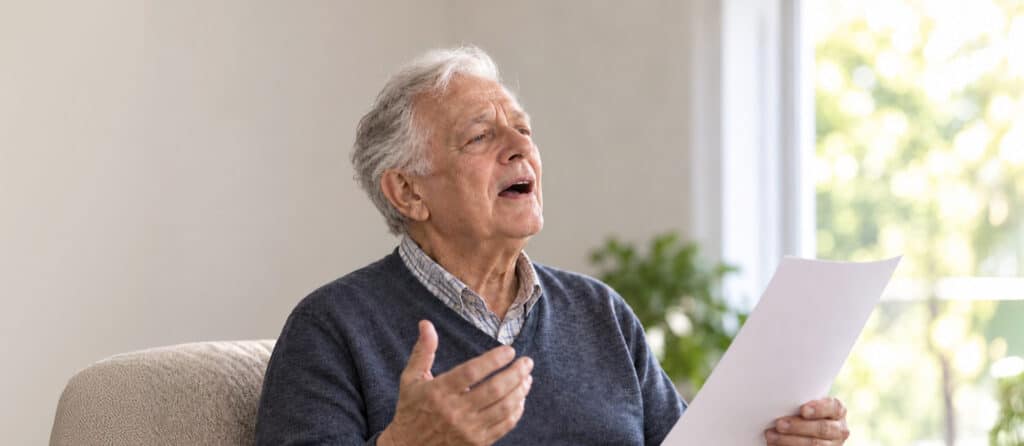
Singing brings people together. It fills a room with rhythm, breath, and connection, and for most people, it is simply enjoyable. For people with Parkinson’s, singing may offer something more: a way to supplement the skills addressed in Parkinson Voice Project’s SPEAK OUT!® Therapy Program. Up to 90% of people with Parkinson’s experience speech and swallowing difficulties, so any activity that supports voice, breath, and expression is worth a closer look. A growing body of research has begun to study group singing and music therapy for Parkinson’s. Here is what that research shows, and how to make the most of it.
What the Research Shows About Your Voice
Building Volume, Breath Support, and Quality of Life
The clearest evidence comes from a study of ParkinSong, a program combining high-effort vocal exercises, breath support training, speech exercises, and group singing. Seventy-five people with Parkinson’s took part. After three months, participants showed improvement in vocal volume, breath support, and voice-related quality of life. Those who sang weekly built more vocal volume than those who sang monthly, suggesting that frequency plays a role. The researchers have called for a larger study with random assignment to confirm these findings.
An earlier study combining 20 hours of speech therapy with 26 hours of choral singing found similar gains in breath support, sustained voice, and speech rhythm. This study did not include a comparison group, so it cannot show that singing alone caused the change.
Not every singing program produces these results. A twelve-week program of weekly 90-minute group singing sessions did not lead to significant change in vocal volume, pitch range, or voice-related quality of life. Taken together, these studies point to a consistent pattern: how a singing program is structured, and how much effort it asks of participants, appears to matter as much as whether people sing at all.
When singing was combined directly with speech therapy, the results were stronger. In a study that placed 33 people with Parkinson’s into speech therapy, singing, or a combined program, the combined group showed the greatest improvement on voice measures, including vocal quality and voice-related handicap (a standard clinical measure of how voice problems affect daily life). Singing appears to work best as a complement to speech therapy such as SPEAK OUT! Therapy, not as a substitute for it.
Changes in Facial Expression
Voice is not the only thing singing may influence. In a study of 10 people who took part in 20 weeks of group music therapy, facial expression improved substantially during both singing and speaking. The study was small and did not include a comparison group, so the finding is best described as promising rather than established.
What the Research Shows About Connection and Care
Reducing Isolation and Building Peer Support
In interviews with 31 people with Parkinson’s, eight Care Partners, and 10 group leaders, participants across all three groups described singing groups as more than a musical activity. Peer support and encouragement to manage Parkinson’s proactively were the most consistent themes, alongside the effects of pandemic-related disruption on group participation.
A study following 95 individuals with Parkinson’s across Australia, the United Kingdom, and South Korea found that a six-month weekly singing program reduced stigma, anxiety, and stress, and improved social support, with the strongest effect in the South Korean group. Choral singing after stroke or Parkinson’s has also been described by participants as a way to manage isolation and low mood, alongside perceived improvements in breathing and voice.
Involving Your Care Partner
Singing’s benefits are not limited to the person with Parkinson’s. A ten-week study following four couples through singing and songwriting found that both partners experienced improved relationships, shared enjoyment, and creative expression, even when the Care Partner did not attend every session. Involve your friends and family, so they can understand the power of INTENT. When a Care Partner takes part alongside you, the practice becomes something you build together.
The Speech & Singing Connection
Why Facilitator Training Matters
Group leaders interviewed about running Parkinson’s singing groups described skills beyond music itself: organizing sessions, reading group needs, and building trust. They also described specific challenges unique to Parkinson’s:
- Differences in physical and cognitive ability among participants
- Difficulty reading facial expression, which can look like disengagement
- Sensitivity needed when giving feedback
- Emotional responses that certain songs can bring up
- Safety considerations around movement
- Difficulty coordinating multipart singing among participants with different vocal ranges
This is why a program built specifically for Parkinson’s, with facilitators trained in these needs, functions differently than joining a general community choir. Speech-language pathologists who are Certified SPEAK OUT! Providers are ideal candidates to facilitate Parkinson’s singing groups, alongside other pertinent professionals.
Singing as a Complement, Not a Replacement
Speech-language pathologists surveyed across French-speaking countries report using music and rhythm for a range of communication needs, though many said they lacked formal training in how to apply it. Researchers describe frameworks that attempt to explain how rhythm supports attention, timing, and the brain’s ability to adapt. This helps explain why structured, high-effort singing produces stronger results than casual group singing, and reinforces what the clinical evidence already shows: singing works best when paired with focused speech therapy such as SPEAK OUT! Therapy, not used on its own.
Where the Evidence Is Strongest and Where More Research Is Needed
More established:
- Vocal volume, particularly with structured, high-effort programs
- Social connection and peer support, a consistent finding across studies
- Anxiety and stress, reduced in several studies, especially internationally
- Quality of life, generally positive in social and emotional domains
Mixed or limited so far:
- Respiratory support and singing voice quality: some positive findings, though evidence remains limited
- Conversational speech and speech intelligibility: mixed and inconsistent results
- Facial expression: promising in small studies, not yet confirmed at larger scale
- Depression: not consistently improved by singing
- Care Partner and spousal relationship benefits: a strong qualitative signal, though not yet measured with objective tools
- Motor symptoms and cognition: not well studied in this body of research
How to Use This Research
If you’re considering group singing alongside your speech therapy, here’s where to start:
- Ask whether a program includes structured, high-effort vocal and breath exercises, like the SPEAK OUT! Mini Workout, not only group singing.
- Look for facilitators trained in Parkinson’s-specific needs.
- Use singing to complement speech therapy such as SPEAK OUT! Therapy, not to replace it.
- Involve your Care Partner, friends, or family, so they can understand the power of INTENT.
- Start SPEAK OUT! Home Practice to build daily repetition alongside any singing you do.
Singing can become one more way to use INTENT, one more habit that helps you REGAIN and RETAIN your speech and swallowing.
Find a Certified SPEAK OUT! Provider today.
References
Di Benedetto, P., Cavazzon, M., Mondolo, F., Rugiu, G., Peratoner, A., & Biasutti, E. (2009). Voice and choral singing treatment: a new approach for speech and voice disorders in Parkinson’s disease. In European Journal of Physical and Rehabilitation Medicine (Vol. 45, Issue 1, pp. 13–19). PubMed. https://pubmed.ncbi.nlm.nih.gov/18987565/
Brieussel, J., Fumel, J., Ott, L., & Basirat, A. (2026). From Neurocognitive Frameworks to Clinical Practice: How Music and Rhythm Are Utilized by Speech-Language Pathologists. American Journal of Speech-Language Pathology, 35(3), 1025–1037. https://doi.org/10.1044/2025_ajslp-25-00234
Elefant, C., Baker, F. A., Lotan, M., Lagesen, S. K., & Skeie, G. O. (2012). The Effect of Group Music Therapy on Mood, Speech, and Singing in Individuals with Parkinson’s Disease — A Feasibility Study. Journal of Music Therapy, 49(3), 278–302. https://doi.org/10.1093/jmt/49.3.278
Elefant, C., Lotan, M., Baker, F. A., & Skeie, G. O. (2012). Effects of music therapy on facial expression of individuals with Parkinson’s disease: A pilot study. Musicae Scientiae, 16(3), 392–400. https://doi.org/10.1177/1029864912458917
Fogg-Rogers, L., Buetow, S., Talmage, A., McCann, C. M., Leão, S. H. S., Tippett, L., Leung, J., McPherson, K. M., & Purdy, S. C. (2015). Choral singing therapy following stroke or Parkinson’s disease: an exploration of participants’ experiences. Disability and Rehabilitation, 38(10), 952–962. https://doi.org/10.3109/09638288.2015.1068875
Hersh, D., Kong, S., & Smith, J. (2023). It’s quite good fun: A qualitative study of a singing/songwriting programme for people with Parkinson’s disease and their spouses. International Journal of Language & Communication Disorders. https://doi.org/10.1111/1460-6984.12926
Irons, J. Y., Hancox, G., Vella-Burrows, T., Han, E.-Y., Chong, H.-J., Sheffield, D., & Stewart, D. E. (2020). Group singing improves quality of life for people with Parkinson’s: an international study. Aging & Mental Health, 25(4), 1–7. https://doi.org/10.1080/13607863.2020.1720599
Mohseni, Z., Mohamadi, R., Amir, S., Arezoo Saffarian, & Jamile Abolghasemi. (2023). Voice improvement following conventional speech therapy combined with singing intervention in people with Parkinson’s disease: A three‐arm randomised controlled trial. International Journal of Language and Communication Disorders. https://doi.org/10.1111/1460-6984.12900
Shih, L. C., Piel, J., Warren, A., Kraics, L., Silver, A., Vanderhorst, V., Simon, D. K., & Tarsy, D. (2012). Singing in groups for Parkinson’s disease (SING-PD): A pilot study of group singing therapy for PD-related voice/speech disorders. Parkinsonism & Related Disorders, 18(5), 548–552. https://doi.org/10.1016/j.parkreldis.2012.02.009
Tamplin, J., Morris, M. E., Baker, F. A., Sousa, T. V., Haines, S., Dunn, S., Tull, V., & Vogel, A. P. (2021). ParkinSong Online: protocol for a telehealth feasibility study of therapeutic group singing for people with Parkinson’s disease. In BMJ Open (Vol. 11, Issue 12, p. e058953). PubMed. https://doi.org/10.1136/bmjopen-2021-058953
Tamplin, J., Morris, M. E., Marigliani, C., Baker, F. A., & Vogel, A. P. (2019). ParkinSong: A Controlled Trial of Singing-Based Therapy for Parkinson’s Disease. Neurorehabilitation and Neural Repair, 33(6), 453–463. https://doi.org/10.1177/1545968319847948